

How To Repair Natural Spectrum Sunlight Lamp That Does Not Turn On?
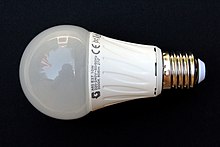 A 230-volt LED calorie-free bulb with an E27 base of operations (x watts, 806 lumens, 3000 Kelvins) | |
| Type | LED, Light bulb |
|---|---|


An assortment of LED lamps commercially available in 2022: floodlight fixtures (left), reading light (centre), household lamps (center right and bottom), and low-ability accent light (right) applications

An 80W Chips on board (COB) LED module from an industrial light luminaire, thermally bonded to the rut sink
An LED lamp or LED light bulb is an electrical light that produces light using light-emitting diodes (LEDs). LED lamps are significantly more free energy-efficient than equivalent incandescent lamps and can be significantly more than efficient than most fluorescent lamps.[1] [2] [3] The most efficient commercially available LED lamps take efficiencies of 200 lumens per watt (Lm/W).[4] [5] [6] Commercial LED lamps have a lifespan many times longer than incandescent lamps.
LED lamps crave an electronic LED driver excursion to operate from mains power lines, and losses from this circuit means that the efficiency of the lamp is lower than the efficiency of the LED fries information technology uses. The driver circuit may require special features to be compatible with lamp dimmers intended for use on incandescent lamps. By and large the electric current waveform contains some amount of baloney, depending on the luminaires' technology.[7]
The LED lamp market is projected to abound from $75.eight billion in 2022 and increasing to $160 billion in 2026.[8]
LEDs come to full brightness immediately with no warm-upwards delay. Frequent switching on and off does not reduce life expectancy as with fluorescent lighting.[ix] Calorie-free output decreases gradually over the lifetime of the LED (see Efficiency droop section).
Some LED lamps are drop-in replacements for incandescent or fluorescent lamps. LED lamps may utilise multiple LED packages for improved low-cal dispersal, heat dissipation, and overall cost. The text on retail LED lamp packaging may show the light output in lumens, the power consumption in watts, the colour temperature in Kelvin or a colour description such as "warm white", "cool white" or "daylight", the operating temperature range, and sometimes the equivalent wattage of an incandescent lamp delivering the same output in lumens.
History [edit]
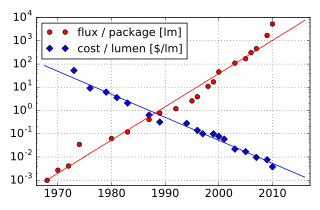
Illustration of Haitz's police force, showing improvement in calorie-free output per LED over time, with a logarithmic scale on the vertical axis
Before the introduction of LED lamps, 3 types of lamps were used for the majority of general (white) lighting:
- Incandescent lights, which produce calorie-free with a glowing filament heated by electric electric current. These are very inefficient, having a luminous efficacy of 10–17 lumens/W, and also have a short lifetime of yard hours. They are being phased out of full general lighting applications. Incandescent lamps produce a continuous black body spectrum of light similar to sunlight, and so produce high Color rendering alphabetize (CRI).
- Fluorescent lamps, which produce ultraviolet light by a glow belch betwixt two electrodes in a low pressure tube of mercury vapor, which is converted to visible light by a fluorescent coating on the inside of the tube. These are more efficient than incandescent lights, having a luminous efficacy of effectually threescore lumens/W, and have a longer lifetime 6,000–15,000 hours, and are widely used for residential and office lighting. Nonetheless, their mercury content makes them a gamble to the surroundings, and they have to be disposed of as hazardous waste matter.
- Metallic-halide lamps, which produce light by an arc between two electrodes in an temper of argon, mercury and other metals, and iodine or bromine. These were the about efficient white electric lights before LEDs, having a luminous efficacy of 75–100 lumens/Westward and have a relatively long bulb lifetime of 6,000–15,000 hours, just because they require a 5–7 minute warmup period earlier turning on, are not used for residential lighting, just for commercial and industrial wide area lighting, and outdoor security lights and streetlights. Like fluorescents, they also contain hazardous mercury.
Considered as electric free energy converters, all these existing lamps are inefficient, emitting more of their input energy as waste rut than as visible light. Global electric lighting in 1997 consumed 2022 terawatthours of energy. Lighting consumes roughly 12% of electrical energy produced by industrialized countries. The increasing scarcity of energy resources, and the environmental costs of producing energy, particularly the discovery of global warming due to carbon dioxide emitted past the burning of fossil fuels, which are the largest source of energy for electric ability generation, created an increased incentive to develop more energy-efficient electric lights.
The first depression-powered LEDs were adult in the early on 1960s, and only produced light in the depression, red frequencies of the spectrum. In 1968, the first commercial LED lamps were introduced: Hewlett-Packard's LED display,[10] which was developed nether Howard C. Borden and Gerald P. Pighini, and Monsanto Company's LED indicator lamp.[ten] Still, early LED lamps were inefficient and could only display deep cherry colors, making them unsuitable for general lighting and restricting their usage to numeric displays and indicator lights.[10]
The get-go loftier-brightness blue LED was demonstrated past Shuji Nakamura of Nichia Corporation in 1994.[11] The beingness of blueish LEDs and high-efficiency LEDs led to the development of the offset 'white LED', which employed a phosphor coating to partially convert the emitted bluish lite to cerise and green frequencies, creating a low-cal that appears white.[12] Isamu Akasaki, Hiroshi Amano and Nakamura were later awarded the 2022 Nobel Prize in Physics for the invention of the blueish LED.[13]
Mainland china further boosted LED research and development in 1995 and demonstrated its first LED Christmas tree in 1998. The new LED technology application then became prevalent at the start of the 21st century past U.s.a. (Cree) and Japan (Nichia, Panasonic, and Toshiba) and then starting 2004 by Korea and China (Samsung, Kingsun, Solstice, Hoyol, and others.)[xiv]
In the US, the Free energy Independence and Security Act (EISA) of 2007 authorized the Department of Energy (DOE) to establish the Bright Tomorrow Lighting Prize competition, known as the "L Prize",[15] the start regime-sponsored technology competition designed to challenge industry to develop replacements for 60 Westward incandescent lamps and PAR 38 element of group vii lamps. The EISA legislation established basic requirements and prize amounts for each of the two competition categories, and authorized up to $20 million in cash prizes.[16] The competition besides included the possibility for winners to obtain federal purchasing agreements, utility programs, and other incentives. In May 2008, they appear details of the competition and technical requirements for each category. Lighting products meeting the competition requirements could apply but 17% of the energy used by almost incandescent lamps in employ today. That same year the DOE also launched the Energy Star program for solid-state lighting products. The EISA legislation also authorized an additional 50 Prize plan for developing a new "21st Century Lamp".
Philips Lighting ceased research on meaty fluorescents in 2008 and began devoting the bulk of its research and development budget to solid-state lighting.[17] On 24 September 2009, Philips Lighting North America became the first to submit lamps in the category to supercede the standard threescore Westward A-19 "Edison screw fixture" light bulb,[eighteen] with a design based on their earlier "AmbientLED" consumer production. On three August 2022, DOE awarded the prize in the 60 Due west replacement category to a Philips LED lamp after 18 months of all-encompassing testing.[19]
Early on LED lamps varied greatly in chromaticity from the incandescent lamps they were replacing. A standard was developed, ANSI C78.377-2008, that specified the recommended color ranges for solid-state lighting products using cool to warm white LEDs with various correlated color temperatures.[twenty] In June 2008, NIST announced the commencement two standards for solid-state lighting in the United States. These standards detail performance specifications for LED light sources and prescribe test methods for solid-country lighting products.
Likewise in 2008 in the United States and Canada, the Energy Star plan began to label lamps that encounter a set of standards for offset, life expectancy, color, and consistency of operation. The intent of the programme is to reduce consumer concerns due to variable quality of products, by providing transparency and standards for the labeling and usability of products available in the market.[21] Free energy Star Certified Calorie-free Bulbs is a resources for finding and comparing Energy Star qualified lamps. A similar program in the United Kingdom (run by the Free energy Saving Trust) was launched to identify lighting products that meet energy conservation and performance guidelines.[22] Ushio released the first LED filament lamp in 2008.[23]Philips released its offset LED lamp in 2009,[24] followed by the world's start 60w equivalent LED lamp in 2022, [25] [26] [27] [28] and a 75 watt equivalent version in 2022. [29]
The Illuminating Applied science Guild of North America (IESNA) in 2008 published a documentary standard LM-79, which describes the methods for testing solid-country lighting products for their light output (lumens), efficacy (lumens per watt) and chromaticity.
Every bit of 2022[update], in the opinion of Noah Horowitz of the Natural Resource Defence force Council, new standards proposed past the United states of america Department of Free energy would likely mean near light bulbs used in the time to come would exist LED.[xxx]
Past 2022 electricity usage in the U.s. had decreased for at least five straight years, due in function to U.Southward. electricity consumers replacing incandescent low-cal bulbs with LEDs due to their energy efficiency and high functioning.[31]
Examples of early adoption [edit]

In 2008 Sentry Equipment Corporation in Oconomowoc, Wisconsin, US, was able to light its new factory interior and exterior nigh solely with LEDs. Initial cost was three times that of a traditional mix of incandescent and fluorescent lamps, but the extra cost was recovered within two years via electricity savings, and the lamps should not need replacing for xx years.[17] In 2009 the Manapakkam, Chennai office of the Indian IT visitor, iGate, spent ₹iii,700,000 (United states of america$lxxx,000) to light 57,000 sq ft (5,300 k2) of office space with LEDs. The firm expected the new lighting to pay for itself within five years.[32]
In 2009 the exceptionally large Christmas tree continuing in front of the Turku Cathedral in Finland was hung with 710 LED lamps, each using 2 watts. It has been calculated that these LED lamps paid for themselves in three and a one-half years, even though the lights run for only 48 days per yr.[33]
In 2009 a new highway (A29) was inaugurated in Aveiro, Portugal; it included the first European public LED-based lighting highway.[34]
By 2022 mass installations of LED lighting for commercial and public uses were becoming common. LED lamps were used for a number of demonstration projects for outdoor lighting and LED street lights. The United States Section of Energy made several reports bachelor on the results of many pilot projects for municipal outdoor lighting,[35] and many additional streetlight and municipal outdoor lighting projects soon followed.[36]
Technology [edit]
LED lamps are often made with arrays of surface mountain LED modules that supervene upon incandescent or meaty fluorescent lamps, mostly replacing incandescent lamps rated from 0.v to 200 watts.
A significant difference from other lite sources is that the light is more than directional, i.e., emitted as a narrower beam.
White light LEDs [edit]

LED lamp used in photography
Full general-purpose lighting requires a white lite, emulating a blackness body at a specified temperature, from "warm white" (like an incandescent bulb) at 2700K, to "daylight" at effectually 6000K. The offset LEDs emitted light in a very narrow band of wavelengths, of a colour characteristic of the free energy band gap of the semiconductor fabric used to make the LED. LEDs that emit white calorie-free are fabricated using two principal methods: either mixing light from multiple LEDs of diverse colors, or using a phosphor to catechumen some of the light to other colors. The light is not the same equally a truthful black trunk, giving a different appearance to colors than an incandescent seedling. Colour rendering quality is specified past the CRI, and every bit of 2022[update] is about 80 for many LED bulbs, and over 95 for more expensive high-CRI LED lighting (100 is the ideal value).[ citation needed ]
RGB or trichromatic white LEDs use multiple LED chips emitting red, green, and blue wavelengths. These 3 colors combine to produce white light. The colour rendering index (CRI) is poor, typically 25 – 65, due to the narrow range of wavelengths emitted.[37] Higher CRI values can be obtained using more than than three LED colors to comprehend a greater range of wavelengths.[ citation needed ]
The 2d basic method uses LEDs in conjunction with a phosphor to produce complementary colors from a single LED. Some of the calorie-free from the LED is absorbed by the molecules of the phosphor, causing them to fluoresce, emitting light of another color via the Stokes shift. The most common method is to combine a blue LED with a yellow phosphor, producing a narrow range of blue wavelengths and a wide band of "yellow" wavelengths actually roofing the spectrum from green to ruby. The CRI value can range from less than seventy to over ninety, although a wide range of commercial LEDs of this type have a colour rendering index around 82.[37] Following successive increases in efficacy, which has reached 150 lm/W on a production footing as of 2022, this type has surpassed the functioning of trichromatic LEDs.[ citation needed ]
The phosphors used in white lite LEDs can requite correlated color temperatures in the range of two,200 One thousand (dimmed incandescent) up to 7,000 K or more.[38]
Color irresolute LED lighting [edit]
Tunable lighting systems employ banks of colored LEDs that tin can exist individually controlled, either using split banks of each color, or multi-chip LEDs with the colors combined and controlled at the chip level.[39] For example, white LEDs of different color temperatures can be combined to construct an LED bulb that decreases its color temperature when dimmed.[twoscore]
LED drivers [edit]
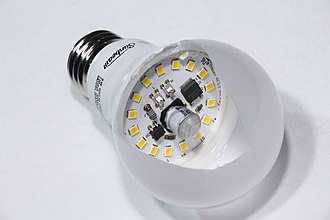
Household LED lamp with its internal LED elements and LED driver circuitry exposed.
LED chips require controlled straight current (DC) electrical power and an appropriate excursion every bit an LED driver is required to convert the alternate electric current from the ability supply to the regulated voltage direct electric current used past the LEDs.
LED drivers are essential components of LED lamps to ensure acceptable lifetime and performance of the lamp. A driver can provide features such as dimming and remote control. LED drivers may be in the aforementioned lamp enclosure as the diode assortment, or remotely mounted from the light-emitting diodes. LED drivers may require additional components to meet regulations for adequate AC line harmonic current.
Thermal direction [edit]
High temperature of LEDs tin can cause premature failure and reduced light output. LED lamps tend to run libation than their predecessors since there is no electric arc or tungsten filament, but they can still cause burns. Thermal direction of high-power LEDs is required to keep the junction temperature of the LED device close to ambient temperature, since increased temperature volition cause increased current, more than heating, more than electric current, and so on until failure. LEDs employ much less power for a given light output, but they do produce some heat, and information technology is concentrated in a very modest semiconductor die, which must be cooled. LED lamps typically include heat sinks and cooling fins. [24] Very high power lamps for industrial uses are frequently equipped with cooling fans.[41] Some place the LEDs and all circuitry in a glass bulb simply similar conventional incandescent bulbs, but with a helium gas filling to conduct oestrus and thus cool the LEDs. [42] Others place the LEDs on a circuit lath with an aluminum backing; the aluminum dorsum is connected thermally to the aluminum base of the lamp using thermal paste, and the base is embedded in a melamine plastic shell.
Efficiency droop [edit]
The term "efficiency droop" refers to the decrease in luminous efficacy of LEDs every bit the electrical electric current increases above tens of milliamps (mA). Instead of increasing current levels, luminance is usually increased past combining multiple LEDs in one lamp. Solving the problem of efficiency droop would mean that household LED lamps would require fewer LEDs, which would significantly reduce costs.
In addition to being less efficient, operating LEDs at higher electric currents produces high temperatures which compromise the lifetime of the LED. Considering of this increased heating at college currents, high-brightness LEDs take an industry standard of operating at only 350 mA, giving a proficient compromise between light output, efficiency, and longevity.[43] [44] [45] [46]
Early suspicions were that the LED droop was caused by elevated temperatures. Scientists proved the opposite to be true – that, although the life of the LED would be shortened, elevated temperatures actually improved the efficiency of the LED.[47] The mechanism causing efficiency droop was identified in 2007 as Auger recombination, which was taken with mixed reaction.[46] A 2022 study conclusively identified Auger recombination as the cause of efficiency droop.[48]
Applications [edit]
LED lamps are used for both general and special-purpose lighting. Where colored light is needed, LEDs that inherently emit light of a single color require no energy-absorbing filters. LED lamps are commonly available as drop-in replacements for either bulbs or fixtures, replacing either an entire fixture (such as LED low-cal panels replacing fluorescent troffers or LED spotlight fixtures replacing similar halogen fixtures) or bulbs (such as LED tubes replacing fluorescent tubes inside troffers or LED HID replacement lamps replacing HID bulbs inside HID fixtures) The differences between replacing a fixture and replacing a bulb are that, when a fixture (like a troffer) is replaced with something similar an LED panel, the panel must be replaced in its entirety if the LEDs or the driver it contains fail since information technology is incommunicable to replace them individually in a applied mode (although the driver is often separate and and then information technology may be replaced), where equally, if simply the seedling is replaced with an LED replacement lamp, the lamp can exist replaced independently of the fixture should the lamp fail. Some LED replacement lamps require the fixture to be modified such every bit past electrically removing the fixture's ballast, thus connecting the LED lamp directly to the mains supply; others tin work without any modifications to the fixture.[49]
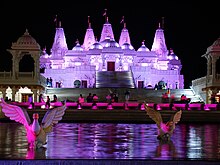

Estimator-led LED lighting allows enhancement of unique qualities of paintings in the National Museum in Warsaw.[50]
White-light LED lamps have longer life expectancy and higher efficiency (more light for the same electricity) than most other lighting when used at the proper temperature. LED sources are compact, which gives flexibility in designing lighting fixtures and good command over the distribution of lite with small reflectors or lenses. Because of the small size of LEDs, control of the spatial distribution of illumination is extremely flexible,[51] and the light output and spatial distribution of an LED array tin can be controlled with no efficiency loss.
LEDs using the color-mixing principle can emit a broad range of colors by changing the proportions of light generated in each primary color. This allows full color mixing in lamps with LEDs of different colors.[52] Unlike other lighting technologies, LED emission tends to be directional (or at least Lambertian), which can be either advantageous or disadvantageous, depending on requirements. For applications where non-directional light is required, either a diffuser is used, or multiple individual LED emitters are used to emit in different directions.
Household LED lamps [edit]
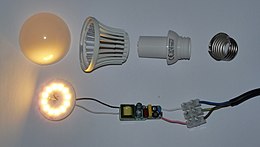
Disassembled LED-light seedling with driver circuit board and Edison screw
Sizes and bases [edit]
LED lamps are fabricated with standard lamp connections and shapes, such as an Edison spiral base, an MR16 shape with a bi-pin base of operations, or a GU5.three (bi-pin cap) or GU10 (bayonet fitting) and are made compatible with the voltage supplied to the sockets. They include driver circuitry to rectify the AC ability and convert the voltage to an advisable value, ordinarily a switched-mode ability supply.
Equally of 2022[update] some LED lamps replaced higher wattage bulbs; for example, ane manufacturer claimed a xvi-watt LED lamp was as bright as a 150 Due west element of group vii lamp.[53] A standard full general-purpose incandescent seedling emits light at an efficiency of about 14 to 17 lumens/Due west depending on its size and voltage. According to the European Spousal relationship standard, an energy-efficient lamp that claims to be the equivalent of a sixty W tungsten lamp must have a minimum light output of 806 lumens.[54]

A pick of consumer LED bulbs bachelor in 2022 equally drop-in replacements for incandescent bulbs in screw-type sockets
Some models of LED lamps are uniform with dimmers every bit used for incandescent lamps[55] (although dimmers for incandescent lighting are not suitable for LEDs). LED lamps often accept directional light characteristics. These lamps are more than power-efficient than compact fluorescent lamps[56] [ better source needed ] and offering lifespans of thirty,000 or more hours, reduced if operated at a higher temperature than specified. Incandescent lamps have a typical life of 1,000 hours,[57] and compact fluorescents about 8,000 hours.[58] The lamps maintain output light intensity well over their lifetimes. Free energy Star specifications require the lamps to typically driblet less than x% later on 6,000 or more hours of operation, and in the worst example not more than than 15%.[59] LED lamps are available with a diversity of color properties. The buy toll is higher than most other lamps – although dropping – merely the college efficiency normally makes full cost of ownership (purchase price plus cost of electricity and changing bulbs) lower.[18]

Loftier-power LED "corn cob" light seedling
Several companies offer LED lamps for general lighting purposes. The technology is improving rapidly and new free energy-efficient consumer LED lamps are available.[sixty] [61] As of 2022[update], in the United States, LED lamps are close to beingness adopted equally the mainstream light source[62] because of the falling prices and because incandescent lamps are being phased out.[63] In the U.S. the Free energy Independence and Security Act of 2007 effectively bans the manufacturing and importing of nearly current incandescent lamps. LED lamps have decreased essentially in price, and many varieties are sold with subsidized prices from local utilities. Nonetheless, in September 2022 the Trump administration rolled dorsum requirements for new, free energy-efficient light bulbs.[64]

A 17 W tube of LEDs which has the same intensity as a 45 Due west fluorescent tube
LED tube lamps [edit]
LED tube lights are designed to physically fit in fixtures intended for fluorescent tubes. Some LED tubular lamps are intended to exist a drop-in replacement into existing fixtures if advisable anchor is used. Others require rewiring of the fixtures to remove the ballast. An LED tube lamp by and large uses many individual Surface-Mounted LEDs which are directional and require proper orientation during installation every bit opposed to Fluorescent tube lamps which emit light in all directions around the tube. Well-nigh LED tube lights bachelor can exist used in identify of T5, T8, T10, or T12 tube designations, T8 is D26mm, T10 is D30mm, in lengths of 590 mm (23 in), 1,200 mm (47 in) and one,500 mm (59 in).
Lighting designed for LEDs [edit]

Newer calorie-free fittings with long-lived LEDs built-in, or designed for LED lamps, have been coming into use as the need for compatibility with existing fittings diminishes. Such lighting does not crave each seedling to incorporate circuitry to operate from mains voltage.
Plants [edit]
Experiments revealed surprising performance and production of vegetables and ornamental plants under LED lite sources.[65] Many constitute species take been assessed in greenhouse trials to make sure that the quality of biomass and biochemical ingredients of such plants is at least comparable with those grown in field weather condition. Plant performance of mint, basil, lentil, lettuce, cabbage, parsley and carrot was measured by assessing both the health and vigor of the plants and the success of the LEDs in promoting growth. Also noticed was profuse flowering of select ornamentals including primula, marigold and stock.[65] [66]
Lite emitting diodes (LEDs) offering efficient electric lighting in desired wavelengths (ruby-red + bluish) which support greenhouse production in minimum fourth dimension and with high quality and quantity. As LEDs are cool, plants tin exist placed very close to light sources without overheating or scorching, requiring much less space for intense tillage than with hot-running lighting.
Specialty [edit]

LED Flashlight replacement bulb (left), with tungsten equivalent (right)

Variable colour temperature LED array in a floodlight
White LED lamps have achieved market authority in applications where loftier efficiency is important at low power levels. Some of these applications include flashlights, solar-powered garden or walkway lights, and bicycle lights. Colored LED lamps are now commercially used for traffic signal lamps, where the ability to emit bright lite of the required color is essential, and in strings of vacation lights. LED automotive lamps are widely used for their long life and small size. Multiple LEDs are used in applications where more light output than available from a unmarried LED is required.
Outdoor lighting [edit]

By nigh 2022 LED technology came to dominate the outdoor lighting industry; earlier LEDs were not bright enough for outdoor lighting. A study completed in 2022 concluded that color temperature and accurateness of LED lights was easily recognized by consumers, with preference towards LEDs at natural color temperatures.[67] LEDs are now able to match the effulgence and warmer color temperature that consumers desire from their outdoor lighting system.
LEDs are increasingly used for street lighting in identify of mercury and sodium lamps due to their lower running and lamp replacement costs. Nevertheless, in that location accept been concerns that the use of LED street lighting with predominantly blueish light can crusade eye damage, and that some LEDs switch on and off at twice mains frequency, causing malaise in some people, and perchance being misleading with rotating machinery due to stroboscopic furnishings. These concerns tin be addressed by apply of appropriate lighting, rather than simple concern with price.[68]
Comparison with other lighting technologies [edit]
See luminous efficacy for an efficiency chart comparing diverse technologies.
Comparing table [edit]
| LED (EcoSmart clear)[69] | LED (V-TAC) [70] | LED (Philips)[71] | LED (Cree)[72] | CFL[73] | Halogen[74] | Incandescent[75] | |
|---|---|---|---|---|---|---|---|
| Purchase toll | $three.29 | $ane.79 | $2.03 | $3.fifty | $0.99 | $1.17 | $0.41 |
| Watts | 6.v | nine | 8.5 | 9.5 | 14 | 43 | lx |
| lumens (mean) | 800 | 806 | 800 | 815 | 775[76] | 750 | 860 |
| lumens/watt | 123.i | 89.half dozen | 94.i | 85.8 | 55.4 | 17.4 | 14.3 |
| Color temperature kelvin | 2700 | 2700 | 2700 | 2700 | 2700 | 2920 | 2700 |
| CRI | fourscore | eighty+ | 80 | 85 | 82 | 100 | 100 |
| Lifespan (hours) | 15,000 | 20,000 | 10,000 | 25,000 | ten,000 | 1,000 | 1,000 |
| Lamp lifetime in years @ half-dozen hours/day | 6.viii | 9.1 | 4.6 | 11.4 | 4.half-dozen | 0.46 | 0.46 |
| Energy toll over xx years @ 12.5 cents/kWh | $36 | $49 | $47 | $52 | $77 | $235 | $329 |
| Toll of replacements of the bulbs over 20years | $10 | $5 | $10 | $7 | $3 | $51 | $xviii |
| Total cost over twentyyears | $45 | $55 | $57 | $59 | $80 | $287 | $347 |
| Total cost per 860lumens | $49 | $58 | $61 | $62 | $88 | $329 | $347 |
| Comparing based on 6 hours use per twenty-four hours (43,800 hours over 20 yrs) | |||||||
In keeping with the long life claimed for LED lamps, long warranties are offered. However, currently there are no standardized testing procedures set up by the Department of Energy in the United States to prove these assertions by each manufacturer.[77] A typical domestic LED lamp is stated to take an "average life" of 15,000 hours (fifteen years at three hours/day), and to support fifty,000 switch cycles.[78]
Incandescent and element of group vii lamps naturally have a ability cistron of 1, only Compact fluorescent and LED lamps use input rectifiers and this causes lower power factors. Low ability factors can outcome in surcharges for commercial energy users; CFL and LED lamps are available with driver circuits to provide any desired power factor, or site-broad ability gene correction can be performed. EU standards requires a power factor improve than 0.4 for lamp powers between two and v watts, better than 0.5 for lamp powers between 5 and 25 watts and above 0.9 for college ability lamps.[79] [80]
Energy Star qualification [edit]
Energy Star is an international standard for energy efficient consumer products.[81] [82] Devices carrying the Energy Star service mark mostly use 20–30% less energy than required past US standards.[83]
Free energy Star LED qualifications:[84]
- Reduces energy costs – uses at least 75% less free energy than incandescent lighting, saving on operating expenses.
- Reduces maintenance costs – lasts 35 to l times longer than incandescent lighting and about 2 to 5 times longer than fluorescent lighting. No lamp-replacements, no ladders, no ongoing disposal program.
- Reduces cooling costs – LEDs produce very little heat.
- Is guaranteed – comes with a minimum three-twelvemonth warranty – far beyond the manufacture standard.
- Offers convenient features – available with dimming on some indoor models and automatic daylight shut-off and motion sensors on some outdoor models.
- Is durable – won't break similar a glass bulb.
To qualify for Energy Star certification, LED lighting products must pass a variety of tests to evidence that the products will display the following characteristics:
- Brightness is equal to or greater than existing lighting technologies (incandescent or fluorescent) and lite is well distributed over the surface area lit by the fixture.
- Light output remains constant over time, but decreasing towards the cease of the rated lifetime (at least 35,000 hours or 12 annums based on use of viii hours per day).
- First-class color quality. The shade of white light appears clear and consistent over fourth dimension.
- Efficiency is as good as or better than fluorescent lighting.
- Light comes on instantly when turned on.
- No flicker when dimmed.
- No off-land power depict. The fixture does non apply power when it is turned off, with the exception of external controls, whose power should not exceed 0.5 watts in the off state.
- Power factor of at to the lowest degree 0.7 for all lamps of 5W or greater.
Limitations [edit]
Many will non work with existing dimmer switches designed for higher power incandescent lamps.[55] The LED lights must be explicitly dimmable and compatible with the make of dimmer switch. Otherwise it will crusade a flicker or glow within the lights.
Color rendering is not identical to incandescent lamps which emit close to perfect blackness-body radiation as that from the sun and for what optics have evolved. A measurement unit chosen CRI is used to limited how the light source'south ability to render the 8 colour sample chips compare to a reference on a scale from 0 to 100.[85] LEDs with CRI beneath 75 are not recommended for use in indoor lighting.[86]
LED lamps may flicker. The result tin exist seen on a wearisome motion video of such a lamp. The extent of flicker is based on the quality of the DC power supply congenital into the lamp structure, unremarkably located in the lamp base. Longer exposures to flickering light contribute to headaches and center strain.[87] [88] [89]
LED life span as a part of lumen maintenance drops at higher temperatures, which limits the power that can be used in lamps that physically replace existing filament and compact fluorescent types. Thermal direction of loftier-power LEDs is a significant cistron in pattern of solid state lighting equipment. LED lamps are sensitive to excessive rut, like most solid state electronic components. Also, the presence of incompatible volatile organic compounds can impair the functioning and reduce lifetime.[ninety]
The long life of LEDs, expected to be about 50 times that of the well-nigh common incandescent lamps and significantly longer than fluorescent types, is advantageous for users but will affect manufacturers as it reduces the market for replacements in the distant hereafter.[17]
The man circadian rhythm tin can be affected past light sources.[91] [92] The effective color temperature of daylight is ~five,700K[93] (bluish white) while tungsten lamps are ~2,700K (yellow).[94] People who have cyclic rhythm sleep disorders are sometimes treated with lite therapy (exposure to intense bluish white low-cal during the day) and dark therapy (wearing bister-tinted goggles at night to reduce bluish calorie-free).[95] [96] [97]
Some organizations recommend that people should not apply bluish white lamps at night. The American Medical Association argues against using bluish white LEDs for municipal street lighting.[98]
Research suggests that the shift to LED street lighting attracts 48% more flying insects than HPS lamps, which could cause direct ecological impacts as well equally indirect impacts such as attracting more gypsy moths to port areas.[99]
Meet also [edit]
- Headlamp § LED
- LED strip light
- LED display
- Listing of emerging technologies
- List of light sources
- Lux
- Photometry (optics)
- Radiation bending
- Solar lamp
- Solid-state lighting
- Spectroscopy
References [edit]
- ^ "How Free energy-Efficient Light Bulbs Compare with Traditional Incandescents". free energy.gov . Retrieved 4 Feb 2022.
- ^ "CFLs vs. LEDs: The Amend Bulbs". greenamerica.org . Retrieved 31 August 2022.
- ^ "Lightbulb Efficiency Comparison Nautical chart". greatercea.org. 24 March 2022. Retrieved 4 February 2022.
- ^ "Dubai Lamp | Philips Lighting". Philips.ae . Retrieved ii Baronial 2022.
- ^ "Lighting world get-go: Philips breaks 200 lumens per watt barrier" (PDF). Philips.com . Retrieved 2 August 2022.
- ^ "Philips and Dubai unveil earth's most efficient LED bulb". newatlas.com. 6 October 2022.
- ^ Ciugudeanu, Calin; Buzdugan, Mircea; Beu, Dorin; Campianu, Angel; Galatanu, Catalin Daniel (12 December 2022). "Sustainable Lighting-Retrofit Versus Dedicated Luminaires-Calorie-free Versus Ability Quality". Sustainability. 11 (24): 7125. doi:10.3390/su11247125. ISSN 2071-1050.
- ^ "LED LIGHTING MARKET - GROWTH, TRENDS, COVID-19 Bear on, AND FORECASTS (2021 - 2026)". Mordor Intelligence . Retrieved 25 September 2022.
- ^ Damir, B (2012). "Longevity of lite bulbs and how to brand them last longer". RobAid. Archived from the original on 19 August 2022. Retrieved 10 August 2022.
- ^ a b c Andrews, David L. (2015). Photonics, Book three: Photonics Applied science and Instrumentation. John Wiley & Sons. p. 2. ISBN9781118225547.
- ^ Nakamura, S.; Mukai, T.; Senoh, Grand. (1994). "Candela-Course High-Brightness InGaN/AlGaN Double-Heterostructure Blue-Light-Emitting-Diodes". Applied Physics Letters. 64 (xiii): 1687. Bibcode:1994ApPhL..64.1687N. doi:10.1063/1.111832.
- ^ 2006 Millennium technology prize awarded to UCSB's Shuji Nakamura. Ia.ucsb.edu (15 June 2006). Last retrieved on 22 June 2022.
- ^ "The Nobel Prize in Physics 2022 – Press release". nobelprize.org . Retrieved 7 Oct 2022.
- ^ "List of Top 10 LED lite manufacturer in Mainland china". Archived from the original on 9 Oct 2022.
- ^ "Fifty-Prize Competition". Us Department of Free energy . Retrieved eleven October 2022.
{{cite web}}: CS1 maint: url-condition (link) - ^ Progress Alerts – 2022 Archived 1 June 2008 at the Wayback Auto, US Department of Energy
- ^ a b c "Fans of L.Eastward.D.'south Say This Bulb's Fourth dimension Has Come". The New York Times. 28 July 2008.
- ^ a b Taub, Eric; leora Broydo Vestel (24 September 2009). "Build a Improve Seedling for a $10 Million Prize". New York Times . Retrieved 4 February 2022.
- ^ Department of Energy Announces Philips Lighting Northward America as Winner of 50 Prize Competition |Department of Energy. Energy.gov (3 August 2022). Retrieved iv February 2022.
- ^ American National Standard for Specifications for the Chromaticity of Solid-State Lighting (SSL) Products Archived eight July 2008 at the Wayback Motorcar. Nema.org. Retrieved ii June 2022.
- ^ Energy Star Program Requirements for CFLS Partner Commitments, 4th edition, dated 03/07/08, retrieved 25 June 2008.
- ^ Energy saving lighting. Energysavingtrust.org.uk. Retrieved xviii January 2022.
- ^ Lin, Judy (5 February 2022). "The Next Generation of LED Filament Bulbs". LEDinside . Retrieved 17 February 2022.
- ^ a b "Philips Primary LEDbulb 'Glow' 7W".
- ^ "Philips LED 60W 806lm Retrofit with Remote Phosphor".
- ^ "StackPath". www.ledsmagazine.com.
- ^ "The 50 Best Inventions of 2009 - TIME". Time. 12 November 2009 – via content.time.com.
- ^ "Philips rolls out 12-watt EnduraLED: Globe's first 60-watt equivalent LED calorie-free bulb". ZDNet.
- ^ "Philips Announces the Earth'southward First LED Replacement for the 75-Watt Seedling".
- ^ Wolverton, Troy (12 March 2022). "Be prepared to say goodbye to the lightbulbs you've loved". The Charlotte Observer. The Mercury News. p. 1C.
- ^ Craven McGinty, Jo (eleven October 2022). "Americans Are No Longer Gluttons for Electricity – Thank the LED Bulb: Subsequently increasing 10-fold between 1950 and 2022, boilerplate residential consumption dipped". The Wall Street Journal.
For more five years, Americans have been doing something decidedly un-American: Nosotros've been using less electricity. . . . [T]oday'due south electronics and appliances are more efficient. New homes are tighter and meliorate insulated. And about important, light-emitting diodes, or LEDs, take replaced traditional incandescent calorie-free bulbs.
- ^ Led'ing the manner, Nitya Varadarajan, 5 October 2009
- ^ "Of the elevation 6 in Turku, led a motility – HS.fi – Domestic". xix November 2009. Retrieved 9 Jan 2022.
- ^ New highway connecting Lisbon to Oporto includes kickoff European LED based lighting in a highway, Aveiro 11 September 2009
- ^ U. Southward. Department of Energy, Solid-State Lighting GATEWAY Demonstration Results Archived 9 June 2022 at the Wayback Automobile (Retrieved 16 July 2022)
- ^ for instance, Seattle: "Seattle Picked to Lead National Effort on LED Street Lights" (Retrieved xvi July 2022); Scottsdale: "LED Streetlight Installation" Archived 28 May 2022 at the Wayback Motorcar (Retrieved 16 July 2022); Ann Arbor: LED street lights (Retrieved 16 July 2022)
- ^ a b Narendran, Nadarajah; Deng, Lei (2002). Ferguson, Ian T; Narendran, Nadarajah; Denbaars, Steven P; Park, Yoon-Soo (eds.). "Color rendering properties of LED lite sources". Proceedings of the SPIE. Solid State Lighting Ii. 4776: 61. Bibcode:2002SPIE.4776...61N. doi:ten.1117/12.452574. S2CID 8122222.
- ^ "Warm white LED lite". Retrieved four February 2022.
- ^ "Tunable White Led Lighting". Retrieved 15 Feb 2022.
- ^ "Warm Glow Event". Philips Lighting . Retrieved ten October 2022. teardown
- ^ Ed Rodriguez (17 Oct 2022). "Cooling high-power LEDs: The four myths near active vs. passive methods". EDN Network . Retrieved nineteen Jan 2022.
- ^ "Philips LED Classic Gasfilled 470lm".
- ^ The LED's nighttime secret. EnergyDaily. Retrieved on 16 March 2022.
- ^ Efremov, A. A.; Bochkareva, N. I.; Gorbunov, R. I.; Lavrinovich, D. A.; Rebane, Y. T.; Tarkhin, D. V.; Shreter, Y. Thou. (2006). "Effect of the joule heating on the quantum efficiency and choice of thermal atmospheric condition for high-ability blueish InGaN/GaN LEDs". Semiconductors. forty (5): 605. Bibcode:2006Semic..40..605E. doi:10.1134/S1063782606050162. S2CID 96989485.
- ^ Smart Lighting: New LED Drops The 'Droop'. Sciencedaily.com (xiii January 2009). Retrieved on iv February 2022
- ^ a b Stevenson, Richard (August 2009) The LED's Dark Secret: Solid-state lighting won't supplant the lightbulb until it tin can overcome the mysterious malady known equally droop Archived 5 February 2022 at the Wayback Auto. IEEE Spectrum
- ^ Identifying the Causes of LED Efficiency Droop Archived 13 Dec 2022 at the Wayback Motorcar, Past Steven Keeping, Digi-Key Corporation Tech Zone
- ^ Iveland, Justin; et al. (23 April 2022). "Crusade of LED Efficiency Droop Finally Revealed". Physical Review Letters, 2022. Science Daily.
- ^ "StackPath". www.ledsmagazine.com.
- ^ "Warsaw Top x" (PDF). Warsaw bout Edition nr v, 2022. p. 20. Archived from the original (PDF) on ix March 2022. Retrieved ane March 2022.
The National Museum in Warsaw is also one of the well-nigh mod in Europe. (...) The LED system allows to adjust the light to every painting so that its unique qualities are enhanced.
- ^ Moreno, Ivan; Avendaño-Alejo, Maximino; Tzonchev, Rumen I. (2006). "Designing light-emitting diode arrays for compatible nigh-field irradiance" (PDF). Applied Optics. 45 (10): 2265–2272. Bibcode:2006ApOpt..45.2265M. doi:10.1364/AO.45.002265. PMID 16607994.
- ^ Moreno, Ivan; Contreras, Ulises (2007). "Color distribution from multicolor LED arrays". Eyes Express. 15 (6): 3607–18. Bibcode:2007OExpr..15.3607M. doi:10.1364/OE.15.003607. PMID 19532605. S2CID 35468615.
- ^ "ledlightingsupplier.co.united kingdom of great britain and northern ireland – Diese Website steht zum Verkauf! – Informationen zum Thema ledlightingsupplier". ledlightingsupplier.co.united kingdom of great britain and northern ireland. Archived from the original on 6 September 2022. Retrieved 26 Baronial 2022.
- ^ Lonsdale, Sarah (vii July 2022). "Green holding: energy-efficient bulbs". The Daily Telegraph. London. Archived from the original on 12 January 2022. Retrieved 8 June 2022.
- ^ a b "Dimming LED lamps: the dos and don'ts". luxreview.com.
- ^ Elisabeth Rosenthal and Felicity Barringer, "Green Promise Seen in Switch to LED Lighting", The New York Times, 29 May 2009
- ^ Taub, Eric (eleven February 2009). "How Long Did Yous Say That Bulb Would Last". New York Times . Retrieved 9 March 2022.
- ^ "Q&A: How much can I save by replacing incandescent bulbs with CFLs?". Consumer Reports. 29 March 2022. Retrieved 4 February 2022.
- ^ "Integral LED Lamps Criteria Evolution" (PDF).
- ^ Taub, Eric A. (16 May 2022) "LED Bulbs for the Home Well-nigh the Marketplace", The New York Times
- ^ Wald, Matthew Fifty. (24 June 2022) "An LED That Mimics an Old Standby", New York Times Green Web log
- ^ Flicker On, Flicker Off, Daniel Gross, Slate, five February 2022
- ^ Philips Flattens the Light Bulb, Mashable, Pete Pachal, 16 December 2022
- ^ NPR:Trump Administration Reverses Standards For Energy-Efficient Lightbulbs https://www.npr.org/2019/09/04/757623821/trump-administration-reverses-standards-for-energy-efficient-light-bulbs
- ^ a b Sabzalian Mohammad R., P. Heydarizadeh, A. Boroomand, M. Agharokh, Mohammad R. Sahba, M. Zahedi and B. Schoefs. 2022. Loftier performance of vegetables, flowers, and medicinal plants in a red-blue LED incubator for indoor plant production. Agronomy for Sustainable Development 34: 879–886 (IF:iii.99)
- ^ Darko Due east., P. Heydarizadeh, B. Schoefs and Mohammad R. Sabzalian. 2022. Photosynthesis under bogus lite: the shift in main and secondary metabolites. Philosophical Transactions of the Royal Society B 369: 20220243 (IF: 6.23)
- ^ "LED advancements drive quality of light gains (Magazine)". LEDs Magazine. 22 April 2022.
- ^ "Highways Mag – Public Health England bug LED street lighting alarm". Highways Magazine (UK). three April 2008. Retrieved nineteen Jan 2022.
- ^ "lx-Watt Equivalent A15 Dimmable Filament Archetype Glass LED Light Bulb, Soft White (iii-Pack)". Habitation Depot. Archived from the original on 5 February 2022. Retrieved 4 Feb 2022.
- ^ "LED Bulbs: LED Bulb – 9W E27 A60 Thermoplastic Warm White". 5-tac.european union. Archived from the original on x September 2022. Retrieved 4 February 2022.
- ^ "60W Equivalent Soft White A19 LED Calorie-free Bulb (ii-Pack)". Home Depot. Archived from the original on 20 October 2022. Retrieved 4 August 2022.
- ^ "Cree 60W Equivalent Soft White (2700K) A19 Dimmable LED Light Bulb (4-Pack)". Home Depot. Retrieved 9 October 2022.
- ^ "Solar LEG Lights – Light-green Energy". Retrieved twenty January 2022.
- ^ "EcoSmart 60-Watt Equivalent Eco-Incandescent A19 Household Light Bulb (4-Pack)". Dwelling house Depot. Archived from the original on 5 February 2022. Retrieved ix October 2022.
- ^ "LED Candle Lamp is capable of replacing up to a 40-watt incandescent bulb". LEDfy. Retrieved iv August 2022.
- ^ "Lightbulbs – LEDs and CFLs offering more choices and savings" (PDF). ConsumerReports. 2022. Archived from the original (PDF) on xi August 2022. Retrieved 21 January 2022.
- ^ Standards Evolution for Solid-State Lighting energy.gov
- ^ "Specification of a typical domestic nine.5W LED lamp". Philips. Archived from the original on xviii November 2022. Retrieved 28 Jan 2022.
- ^ PF vs. Ability in EU. ledon.at
- ^ "Commission Regulation (European union) No 1194/2012" (PDF). EUR-Lex. 14 December 2022. p. 13. Retrieved 5 October 2022.
- ^ "The Clinton Presidency: Protecting Our Surroundings and Public Wellness". The White House . Retrieved 4 February 2022.
- ^ "History of Energy Star". Archived from the original on 27 March 2022. Retrieved 27 March 2022.
- ^ Alena Tugend (x May 2008). "If Your Appliances Are Avocado, They're Probably not Green". New York Times . Retrieved 29 June 2008.
- ^ "Energy star products specs". Retrieved four September 2022.
- ^ Appendix B: Calculating color rendering metrics. lrc.rpi.edu
- ^ Free energy Star Programme Requirements for Solid State Lighting Luminaires. (PDF). Retrieved ii June 2022.
- ^ "Characterizing and Minimizing LED Flicker in Lighting Applications" Steven Keeping (2012). Retrieved on 2 Feb 2022.
- ^ "A Review of the Literature on Lite Flicker: Ergonomics, Biological Attributes, Potential Health Effects, and Methods in Which Some LED Lighting May Introduce Flicker," IEEE Standard P1789, February 2022.
- ^ Open up alphabetic character from Alex Baker, Lighting Program Managing director, Free energy Star, dated 22 March 2022.
- ^ "Cree XLamp LEDs Chemical compatibility" URL: https://www.cree.com/led-components/media/documents/XLamp_Chemical_Comp.pdf
- ^ West, Kathleen E.; Jablonski, Michael R.; Warfield, Benjamin; Cecil, Kate S.; James, Mary; Ayers, Melissa A.; Maida, James; Bowen, Charles; Sliney, David H.; Rollag, Mark D.; Hanifin, John P.; Brainard, George C. (ane March 2022). "Blue light from light-emitting diodes elicits a dose-dependent suppression of melatonin in humans". Periodical of Applied Physiology. 110 (three): 619–626. doi:x.1152/japplphysiol.01413.2009. PMID 21164152. S2CID 23119076.
- ^ Cajochen, Christian; Frey, Sylvia; Anders, Doreen; Späti, Jakub; Bues, Matthias; Pross, Achim; Mager, Ralph; Wirz-Justice, Anna; Stefani, Oliver (1 May 2022). "Evening exposure to a light-emitting diodes (LED)-backlit computer screen affects cyclic physiology and cognitive performance". Journal of Applied Physiology. 110 (5): 1432–1438. doi:10.1152/japplphysiol.00165.2011. PMID 21415172.
- ^ Williams, D. R. (2004). "Sun Fact Sail". NASA. Retrieved four Feb 2022.
- ^ "Microscopy Resource Center | Olympus Life Science". olympus-lifescience.com.
- ^ "Circadian Rhythms". nigms.nih.gov.
- ^ Fahey, Christopher D.; Zee, Phyllis C. (one Dec 2006). "Circadian rhythm sleep disorders and phototherapy". Psychiatric Clinics of N America. 29 (4): 989–1007, abstract ix. doi:10.1016/j.psc.2006.09.009. PMID 17118278.
- ^ Appleman, Kenneth; Figueiro, Mariana 1000.; Rea, Mark S. (1 May 2022). "Controlling calorie-free–nighttime exposure patterns, rather than sleep schedules, determines circadian stage". Sleep Medicine. xiv (five): 456–461. doi:ten.1016/j.sleep.2012.12.011. PMC4304650. PMID 23481485.
- ^ "AMA Adopts Community Guidance to Reduce the Harmful Human and Environmental Effects of High Intensity Street Lighting". ama-assn.org . Retrieved 4 February 2022.
- ^ Pawson, South.; Bader, Thou. (October 2022). "LED lighting increases the ecological impact of calorie-free pollution irrespective of colour temperature". Ecological Applications. 24 (7): 1561–1568. doi:10.1890/xiv-0468.1. PMID 29210222. Retrieved half dozen January 2022.
Farther reading [edit]
- E. Fred Schubert (2006). Calorie-free-Emitting Diodes . Cambridge University Printing. ISBN978-1-139-45522-0.
- Krigel, A; Berdugo, M; Picard, E; Levy-Boukris, R; Jaadane, I; Jonet, L; Dernigoghossian, M; Andrieu-Soler, C; Torriglia, A; Behar-Cohen, F (2016). "Low-cal-induced retinal damage using unlike light sources, protocols and rat strains reveals LED phototoxicity" (PDF). Neuroscience. 339: 296–307. doi:10.1016/j.neuroscience.2016.10.015. PMID 27751961. S2CID 1619530.
External links [edit]
-
 Media related to LED lamps at Wikimedia Commons
 - east-lumen.eu – a website from the European Commission most the 2nd generation of energy-saving lamps
- Some cities are taking another look at LED lighting after AMA alarm (25 Sep 2022), The Washington Post

Source: https://en.wikipedia.org/wiki/LED_lamp
Posted by: reedfreyed.blogspot.com
0 Response to "How To Repair Natural Spectrum Sunlight Lamp That Does Not Turn On?"
Post a Comment